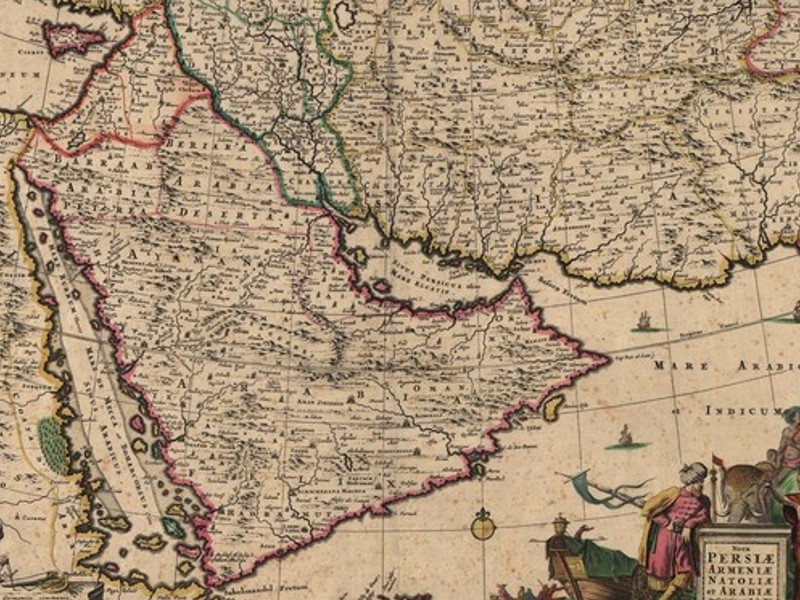
A map of ancient Arabia depicts a region with numerous tribal territories and diverse geography. Just like any other map out there, this ancient Arabian map also has several key features that you can expect to see. These include the following:
Table of Contents:
Settlements and Cities
Different ancient settlements and cities dotted the expanse of Arabia. Some of these include some of the most popular ones such as Sana’a, Petra, Medina, and Mecca. These cities usually served as the hubs for the country’s religion, culture, and economy.
A map of ancient Arabia has several key features that you can expect to see.
Coastal Areas
There are extensive coastlines across the Arabian Peninsula along the Arabian Sea and the Red Sea. These coastal regions were critical for fishing, maritime trade, as well as contact with the rest of the civilizations.
Religious and Cultural Centres
Just so you know, Arabia is the birthplace of the Islamic religion, and a map of ancient Arabia might include certain locations or areas linked with some of the initial years of the said religion. These may include places such as the Prophet Muhammad’s Mosque in Medina located in Medina and the Kaaba in Mecca.
Mecca is the oldest and most famous city in the world since it is where Adam and Eve were sent to, and where Abraham lived and built the Kaaba, then why is there no reference to it in any documentation until 741 AD, and why can it not be found on any of the maps of ancient Arabia until well into the 16th century?
Desert Regions
There are huge expanses of deserts covering most of Arabia including the Arabian Desert and the Rub’ al Khali or Empty Quarter. The said deserts played an important role in forming the nomadic lifestyle of most of the ancient Arabian tribes.
Historical Sites
A map of ancient Arabia may also highlight some historical sites. These may include ancient temples, forts, and wells, all of which were crucial in both the historical and cultural context of the Arabian region.
Mountainous Areas
Certain areas of Arabia including the Hijaz region located along the country’s western coast, are known for their mountainous terrain. These mountains served as natural barriers with a significant impact on the settlement patterns of various tribes.
Oases
Oases located right in the heart of the arid deserts served as critical locations for trade and settlement. These areas acted as a source of vegetation and water that supported not only human habitation but also different economic activities.
Trade Routes
Ancient Arabia served as a crossroads for the trade routes that connected Asia, Africa, and the Mediterranean world. The major trade routes including the Incense Route allowed the exchange of goods such as incense, precious metals, and spices.
Tribal Territories
Traditionally, Arabia was organized into several tribal societies that have numerous settled and nomadic tribes that inhabit certain regions. The tribal territories were fluid, which means that they could change depending on different factors such as conflicts and resource availability.
These are only some of the primary features that can often be seen on a map of ancient Arabia. However, it’s important to keep in mind that these specific details would still vary according to the particular period that is being depicted on the map. This is because the region itself has a rich and interesting history that spans thousands of years.
So go ahead and look for these features, and if you don’t find them, it’s fine as long as the map itself is still an excellent depiction of Arabia during the bygone era.
A topographic map of Europe looks like it was designed by someone who enjoys watching travellers overestimate their fitness, underestimate gravity, and question their snack choices halfway up a hill that looked suspiciously flat on a standard map. Read more.